Q. A parallel computer is the computer system capable of
- Parallel computing
- Centralized computing
- Decentralized computing
- Distributed computing
Answer: Parallel Computing
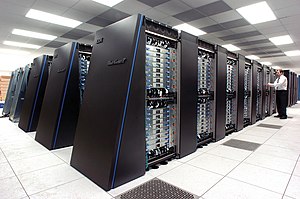
Parallel computing is a type of computation in which many calculations or the execution of processes are carried out simultaneously. Large problems can often be divided into smaller ones, which can then be solved at the same time. There are several different forms of parallel computing: bit-level, instruction-level, data, and task parallelism. Parallelism has long been employed in high-performance computing, but it's gaining broader interest due to the physical constraints preventing frequency scaling. As power consumption (and consequently heat generation) by computers has become a concern in recent years, parallel computing has become the dominant paradigm in computer architecture, mainly in the form of multi-core processors.
Types of parallelism
- Bit-level parallelism
- Instruction-level parallelism
- Task parallelism
- Superword level parallelism
Classes of parallel computers
- Multi-core computing
- Symmetric multiprocessing
- Distributed computing
- Specialized parallel computers
A system is said to be a Parallel System in which multiple processor have direct access to shared memory which forms a common address space.Usually, tightly-coupled systems are referred to as Parallel System. In these systems, there is a single system-wide primary memory (address space) that is shared by all the processors. On the other hand Distributed System are loosely-coupled system.
Parallel computing is the use of two or more processors (cores, computers) in combination to solve a single problem.


